Article
Tengiva vs CRM | Imagine a CRM That Updates Itself
What every other system does
Every CRM, ERP, and PLM on the market, Salesforce, SAP, HubSpot, Coupa, Infor, even the most sophisticated fashion-specific tools like Centric or BlueCherry, treats contact data as your data about them. You own it, you maintain it, you update it. When a sales rep at a supplier leaves, you find out when an email bounces. Then someone has to track down the new contact, update the record manually, and hope every other system that touched that contact gets updated too. It almost never does cleanly.
What Tengiva built is structurally different
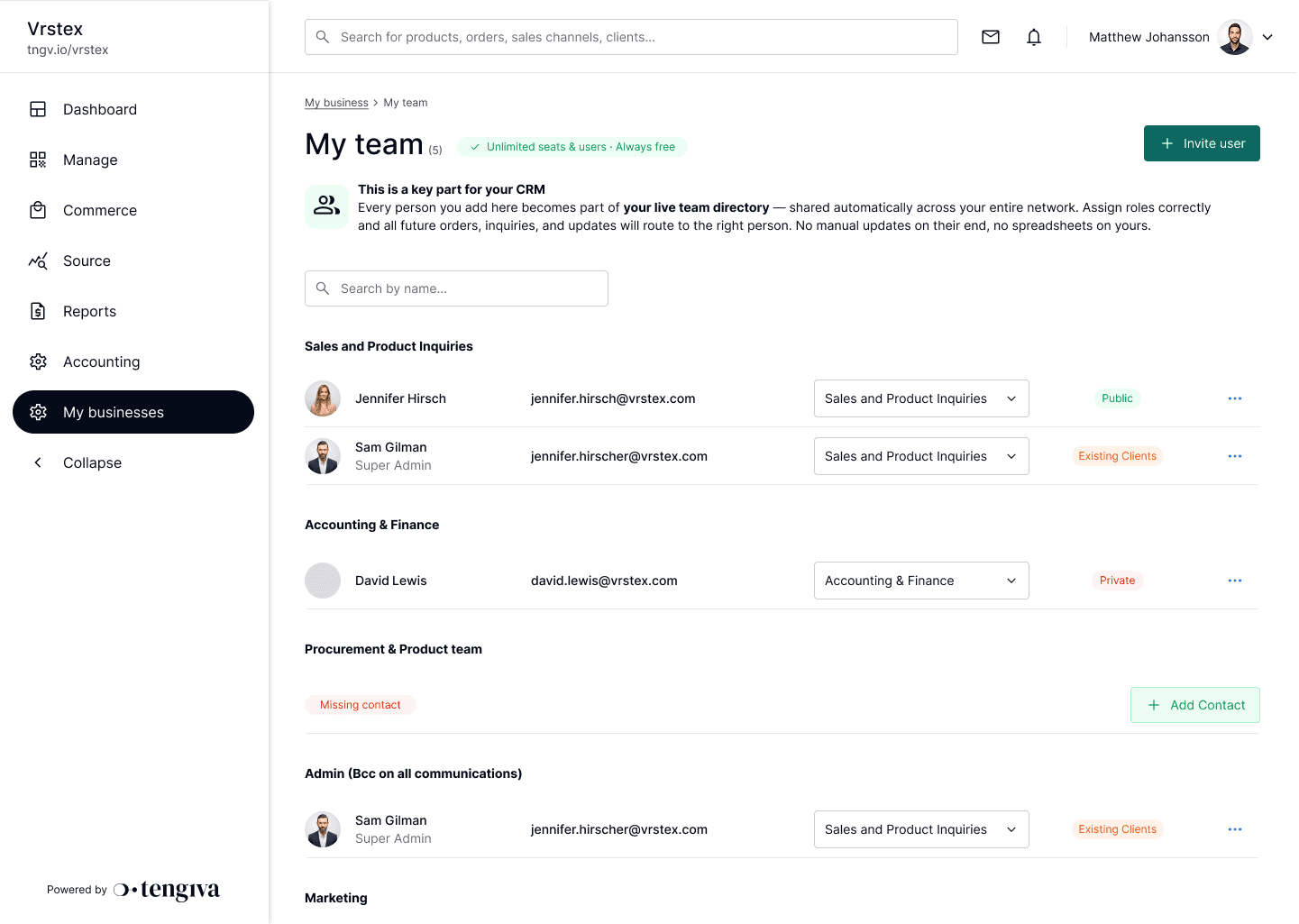
With Tengiva's software, every company owns and maintains their own team data. Companies don't hold a copy of their supplier's contacts. They hold a live reference to their record. When they update it, every company connected to them sees the current version instantly. There is no sync problem because there is only one source of truth, and it belongs to the person who actually knows when it changes.
That's not a feature. That's a fundamentally different way of thinking about B2B data.
Why no one else has done this
Most CRMs were built around the assumption that one company is the center of the universe. Customers are objects to be managed, not participants in a shared system. The value was in owning the data. Tengiva's approach only works because both sides are on the same platform, which is exactly what vertical B2B software makes possible. A horizontal CRM like Salesforce can never do this. They will never get a company's suppliers and buyers into the same system simultaneously.
History is never lost
When a contact changes, the relationship doesn't. Every order, conversation, and transaction stays attached to the business, not to the individual who handled it. When that person leaves, the institutional memory stays intact. On both sides.
What Tengiva is, and what it isn't
Tengiva is built for the relationships that already exist and the ones built in person, at trade shows, through referrals, across active supply chains. Suppliers or buyers share a unique link, and from there, should they both accept, because nobody wants to get spammed, the relationship in Tengiva's ecosystem begins. When a supplier welcomes a new team member, their entire client network is updated automatically. When a brand or retailer adds a new procurement contact, every supplier they work with sees it immediately. It works both ways, across every connection in the network. Tengiva is not built for cold outreach. There is no prospecting tool, no bulk email sequence, no lead scoring. That is a deliberate choice. The contacts in a Tengiva network are people already known or chosen to work with. That's exactly what makes the live directory meaningful. Every connection in it is real.
Tengiva didn't set out to build a CRM. They built something more specific, and more useful. A live directory of the relationships that already matter to a business, maintained by the people who know them best.
Welcome to your new Live team directory: